
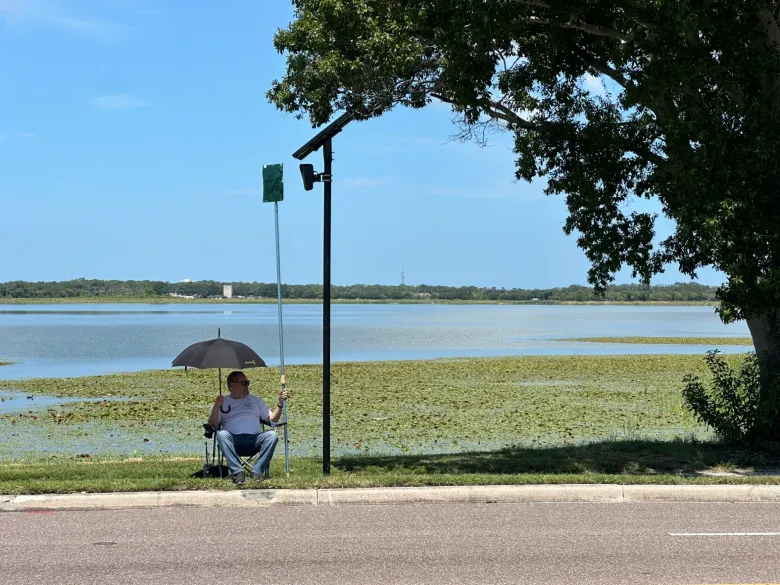
When 77-year-old Carl Gunn noticed a camera mounted on a 12-foot pole outside his St. Petersburg neighborhood, he decided to investigate. He soon learned that it was operated by Flock Safety, a private company whose AI-powered license plate readers capture information about passing vehicles and upload it to a searchable database.
Gunn believed that the camera was an unacceptable invasion of his privacy. So, armed with a lawn chair, a pool skimmer, and a homemade sign that read “DOWN WITH FLOCK CAMERAS,”Gunn put on a one-man protest It was a simple protest, but it conveyed a powerful message: Americans should not have to accept constant government surveillance simply because the technology enabling it has become available.
Flock cameras and other AI-powered surveillance technologies keep U.S. citizens under constant surveillance, with no reprieve. Unlike conventional security cameras, Flock cameras automatically read license plates and use artificial intelligence to record details about passing vehicles. Their systems can identify a car’s make, model, dents, and even bumper stickers. This information can then be searched for across a vast network of cameras, allowing authorities to reconstruct where a vehicle has traveled.
Supporters argue that these tools help law enforcement solve crimes. But public safety cannot become a blank check for monitoring every person who drives to work, visits a friend, or participates in a lawful protest, or simply goes to the grocery store. Americans should not worry about their movements around their communities being recorded and cataloged.
St. Petersburg, for example, has around 50 Flock cameras, including cameras near parks, stores, neighborhood entrances, and a youth recreation center. Most residents who pass them have no idea how much information is being collected or which agencies may ultimately gain access to it. This issue is a bipartisan concern. Most Americans are rightly concerned. Three-quarters of American voters now support limits on AI surveillance, opposing the indiscriminate monitoring of civilians that we see today.
Gunn himself is a Republican, but opposition to mass surveillance does not belong to one political party. Both conservatives who believe in limited government and progressives who champion civil liberties should be able to agree that Americans deserve robust privacy protections. The Constitution protects everyone, regardless of ideology. Gunn also demonstrated how citizens can resist invasive technology peacefully and lawfully. If the Constitution is going to withstand the rise of AI-powered surveillance, Americans must speak out and demand action from their elected officials. It is time to consign Flock cameras and other automated license plate readers to the dustbin of history.
One citizen standing beside one camera cannot dismantle a nationwide surveillance network. But Gunn’s protest reminds us that democratic change often begins when an ordinary person refuses to remain silent. Elected officials should listen and establish firm limits on AI surveillance before constant monitoring becomes an irreversible feature of American life.
Not all heroes wear capes; some carry pool skimmers.